In terms of mainstreaming sustainability in financial decision-making, there has been considerable progress with this in recent years.
In the UAE, regular meetings of the National Dialogue for Climate Ambition (NDCA) discuss developments in this sphere, with the October 2023 gathering, for example, seeing MOCCAE former minister, Mariam bint Mohammed Almheiri, call on companies to take up the Climate Responsible Companies Pledge – an undertaking to intensify efforts to combat climate change.
A new, National Carbon Registry was also introduced, with this aiming to give companies a tool to monitor, measure and trade greenhouse gas emissions (GHGs). [1] Both these initiatives help integrate sustainability into company decision making.
Similarly, climate change preparedness planning is now becoming more widespread. A recent joint plan by Marsh insurers and the Dubai Electricity and Water Authority (DEWA), for example, identified a three-stage approach to this: climate risk identification, climate impact assessment, and climate adaptation recommendation. This was then applied to the Mohammed bin Rashid al-Makhtoum Solar Park, leading to a series of adaptations to hardware (for example, better surface water management), software (e.g. protective maintenance against the impact of high temperatures) and emergency response procedures (a detailed emergency response plan was drawn up). [2]
Financing
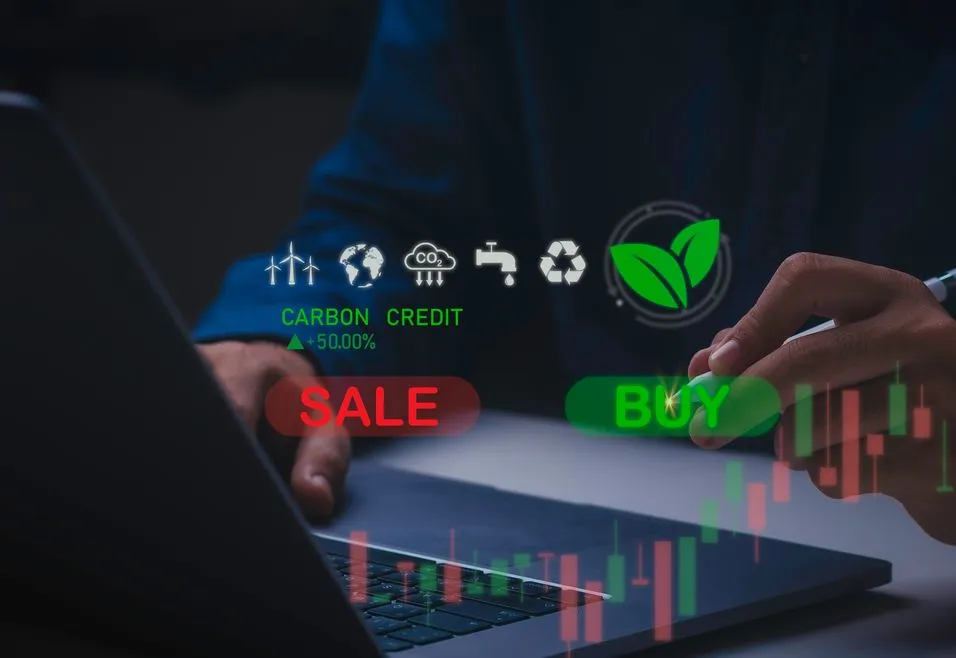
The supply of sustainable financial products has also been increasing, as green bond issuance grows in the UAE and beyond. At the same time, the development of carbon markets has been a recent focus in the country, with Dubai Financial Market (DFM) launching a short pilot programme at COP28. [3]
This introduced two carbon credit projects from DEWA and four from international sources, with 24 project developers, partners and other market participants set to take part in the new platform. All the projects involved were verified by institutions such as the UN Clean Development Mechanism and the VERRA Verified Carbon Standard (VCS). [3] [4]
The UAE is also home to other carbon credit initiatives, such as Blue Carbon, which has purchased extensive forest assets in Africa, and the UAE Carbon Alliance, which includes Masdar, the Mubadala sovereign wealth fund and First Abu Dhabi Bank. At COP28, this group announced a commitment to make the UAE “a leading hub for high integrity, high quality carbon markets.” [5]
Under the UAE Presidency, COP28 saw some progress on these issues, with six independent crediting programmes (ICPs) – including VERRA and Gold Standard, the Global Carbon Council and Architecture for REDD+ Transactions (ART) – joining forces to promote high integrity carbon markets. [6]
Then, at COP29 in November 2024, a key breakthrough came with the full operationalisation of Article 6 of the Paris Agreement. [7] This should provide a clear rule book for carbon market pricing, opening the way to unlocking around $1 trillion annually in public and private climate financing by 2050.
COP29 also saw a new, $300 billion collective quantified goal (NCQG) set for catalysing funding flows to developing countries. [8]
In addition, at COP28 the UAE Banks Federation, which represents some of the world’s largest lenders, also announced a landmark commitment to mobilise AED1 trillion in sustainable finance by 2030. [9]
Making sure that financing goes to support sustainable projects that the real sector can also get behind is naturally vital, if public and private sector initiatives are to get off the ground. Regulators have a sometimes decisive role in enabling this relationship and helping it grow.
An example of this is in green building. COP28 saw eight leading UAE developers endorse the Cement and Concrete Breakthrough and Buildings Breakthrough agendas, which aim to accelerate decarbonisation in these sectors. COP29 then added the formalisation of the Intergovernmental Council on Buildings and Climate (ICBC). [10] This aims to push forward the Declaration of Chaillot, adopted by 70 countries in Paris in March 2024 and including a range of commitments on green building practices. [11]
On a local level, too, the UAE authorities have sought to bring together companies with experts, regulators, financial institutions and other stake holders to promote emissions reduction, energy efficiency, decarbonisation and climate resilience. They have also come to exchange ideas and listen to private sector experiences.
Also helping with this will be the Global Climate Finance Centre (GCFC), based in Abu Dhabi.
This has three core functions: research, policy and innovation; advisory and stakeholder engagement; and a climate finance academy. The aim is for these to work together to build capacity in the UAE, scale up green finance activity and catalyse international investment. Nine founding members were also announced, with these including Masdar, the World Bank Group, HSBC, Blackrock, the ADGM and knowledge-based economy driver ADQ. [12]
A further UAE initiative – in partnership with the US – is the Agriculture Innovation Mission for Climate (AIM4C). This is committed to investing $16 billion in climate-smart agriculture and food systems and has so far gained the support of 600 state and non-state partners, bringing in over $17 billion in investments. [13]
COP30’s Baku to Belem initiative now aims to take the next step: mobilising $1.3 trillion annually by 2035 to support climate action in developing countries.